Websites for Contractors
Plumbers, HVAC, roofers, electricians, and builders. Sites built for a customer standing in a flooded utility room with a phone in one hand and three competitor tabs open.
Trades we build and host for
A Trades Website Has One Job
Make the phone ring. That is it. Not win a design award, not tell your company story at length, not impress another web designer. A visitor lands on your site with a specific problem and a limited amount of patience, and the site either gets them to a phone call or a quote request in the next thirty seconds or it does not.
Trades are unusual among local businesses in three ways that should change how the site is built. The intent is high: somebody searching for an emergency plumber is not researching, they are hiring in the next few minutes. The context is mobile and often awkward: a phone, outdoors or in a basement, sometimes on a weak rural signal. And the value of a single conversion is large enough that a handful of jobs pays for the entire website.
Put those together and the priorities become obvious, which is why it is strange how many contractor sites get them backward. The number should be impossible to miss, not tucked in the footer. Each service should have its own page, not share a bulleted list. The gallery should live where somebody is deciding, not on a separate page nobody clicks. And a quote request should hit your phone as a text, not wait in an inbox until Monday.
We are in Murray, Kentucky, and we have been building and hosting sites for trades and service businesses across the region since 2015. Cooksey Plumbing, TriTurf Sod, Hughes Farm Service, and Superior Cleaning are all still online and still running on our servers.
The Checklist
Eight Things Every Contractor Site Needs
Most trades sites are missing at least three of these. Check yours against the list, whether or not you ever call us.
Click-to-call that never scrolls away
A tappable phone number visible on every screen at every scroll position. The majority of your visitors are on a phone, and a large share of them arrived intending to call rather than read. Every extra tap between them and a ringing phone costs jobs, and burying the number in a footer is the most common and most expensive mistake on trades websites.
A page for every service
Nobody searches "plumbing services." They search "water heater replacement," "slab leak repair," or "sewer camera inspection." A single combined services page is not really about any of those, so it competes weakly for all of them. A dedicated page per service, with a few hundred honest words and photos of you doing that exact work, is the structural difference between a site that produces calls and a site that just exists.
Pages for the towns you drive to
Local results shift heavily with where the searcher is standing, so a company listed in one town frequently does not appear for the same search 20 miles away. Real pages per town, describing what you actually do there and how far out you go, capture work you are already willing to drive to. Not the same paragraph with the town name swapped, which has been ignored for a decade.
Before-and-after galleries, organized
Trades buying decisions are visual, and one giant unlabeled gallery is a scrapbook rather than a sales tool. Photos belong on the service page they illustrate, captioned with what the job was, roughly where, and what was involved. Take them on your phone. Being real and being labeled matters far more than being professionally lit.
Reviews on your own site
Your Google reviews are doing work in the search results, and they should be doing more work on the page somebody lands on afterward. Pulling real reviews onto the relevant service pages, with the customer’s town where you have permission, turns a stranger’s recommendation into the last thing a visitor reads before they tap the number.
License, insurance, and bonding, stated plainly
A homeowner is about to let a stranger into their house, and a property manager is checking whether you can be on site at all. Say it in plain words with the numbers where applicable, near the top, not hidden on an About page. It costs nothing and it removes the single largest objection a first-time customer has.
Forms that text your phone
A quote request should reach you as a text within seconds, not sit in an inbox until you check email after supper. The company that responds first wins a disproportionate share of the work, and the advantage decays fast. Every form we build emails you and texts you at once, and can route to a crew leader or office manager too.
Speed, because your customers are in a hurry
Your visitor is standing in a flooded utility room or sitting in a truck on cellular with three competitor tabs open. A six-second page has already lost to a two-second one. We compress every image, keep scripts minimal, cache every page, and put the phone number in the first chunk of HTML so it paints before anything decorative.
Why the Details Matter
The Economics Are Different for Trades
Most trades traffic is mobile
Design decisions that feel minor on a laptop are decisive on a phone. Thumb-reachable buttons, a number in the header, and forms short enough to complete one-handed.
Emergency searches convert immediately
"Emergency plumber near me" is not a research query. That visitor is calling somebody in the next two minutes, and the only question is whose number was easiest to tap.
First response usually wins
A form filled at 8pm Saturday and answered Monday morning is generally a job somebody else did on Sunday. Routing leads to a phone by text is the cheapest revenue fix available.
A quote is worth a real job
When one converted lead is worth hundreds or thousands of dollars, the cost of the entire website is recovered by a handful of jobs. That math is different from most local businesses.
Starter sites begin at $1,499 and business sites at $3,499. Most trades businesses want the business tier because the strategy above needs a page per service and per town. The full pricing picture is on our website cost guide.
Recent Work
Trades and Service Sites We Built
All still online, all still hosted and maintained by us.

Cooksey Plumbing
cookseyplumbing.us
Local plumbing company built around the two things that decide a service call: showing up in local search and making the phone number impossible to miss on a phone.
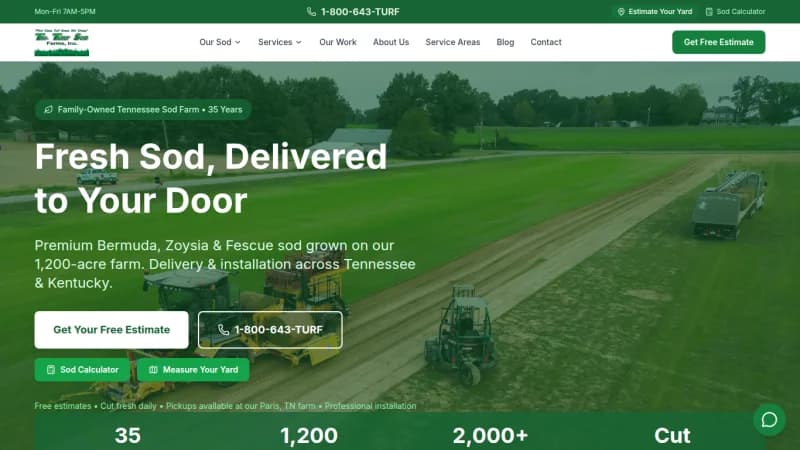
TriTurf Sod
triturfsod.com
Sod farm serving western Kentucky, with a product-forward layout that makes it easy to see what they grow, where they deliver, and how to get a quote.

Hughes Farm Service
hughesfarmservice.com
Farm service business with a straightforward layout an outdoor, on-the-move audience can navigate without hunting for anything.
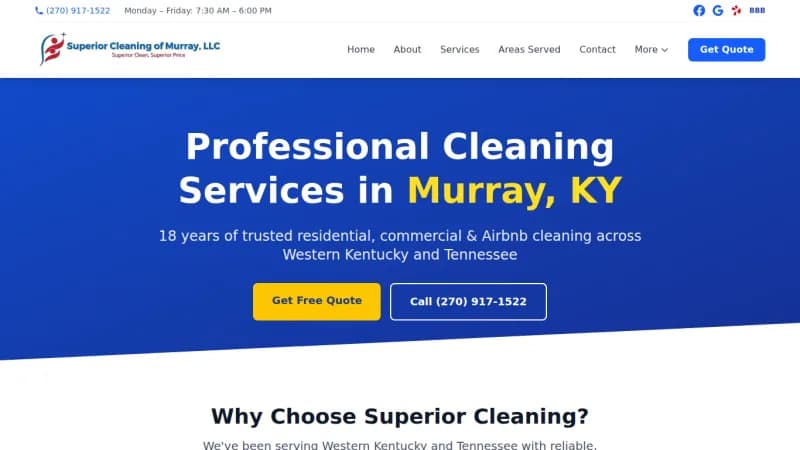
Superior Cleaning of Murray
superiorcleaningofmurray.com
Service company covering multiple towns, structured so that specific local searches land on the page that answers them and ends in a booked job.
A Trades Site Should Change Through the Year
Almost every trade swings with the calendar or the weather, and almost no trades website reflects it. The businesses that quietly outperform are the ones where somebody moves the relevant service to the front before demand arrives, rather than three weeks after it started.
None of this is complicated. It is fifteen minutes of work a few times a year, and it is exactly what our care plan is for.
- HVAC: move cooling to the front in May, heating in September
- Roofing and gutters: a storm-damage page published within days of a storm
- Concrete and excavation: weather-driven availability updates
- Landscaping and sod: a spring installation page ahead of the season
- Plumbing: a freeze and burst-pipe page every winter
- All trades: holiday and after-hours availability, updated honestly
All of that is covered on the $49 a month care plan, usually the same business day you ask.
FAQ
Contractor Website Questions
Six things, and most trades sites are missing at least three of them. A phone number that is tappable and visible on every screen without scrolling, because the majority of your visitors are on a phone and half of them intend to call rather than read. A separate page for each service you sell, because search engines match specific pages to specific searches and one combined services page competes for nothing. Pages for the towns you actually drive to, since local results shift heavily with where the searcher is standing. A real gallery of your own work, because trades buying decisions are visual and stock photos are transparently not your jobs. Reviews pulled onto your own site rather than left only on Google. And your license, insurance, and bonding stated plainly, because a homeowner about to let a stranger into their house is looking for exactly that.
If you want to be found for those services, yes. Think about what somebody actually types. They do not search "plumbing services." They search "water heater replacement," "slab leak repair," "sewer line camera," or "tankless water heater install." A single services page mentioning all of those in a bulleted list is not really about any of them, so it competes weakly for all of them. A dedicated page for water heater replacement, with a few hundred words about what the job involves, what it typically costs, how long it takes, and photos of you doing it, has a genuine chance at that search. This is the single biggest structural difference between trades sites that produce calls and trades sites that sit there.
More than for almost any other kind of business, for a reason specific to your customers. Your visitors are frequently standing in a flooded utility room, sitting in a truck, or looking at a roof, on a phone, on cellular, sometimes with a weak signal in a rural area. They are not browsing, they are in a hurry, and they have three tabs open with your competitors in them. A site that takes six seconds to paint has already lost to the one that took two. That is why we build light on purpose: compressed and correctly sized images, minimal scripts, caching in front of every page, and the phone number in the first chunk of HTML so it renders before anything decorative does.
It should reach your phone as a text within seconds, not sit in an email inbox until you check it after supper. The research on this is unambiguous and it matches what every contractor we work with reports: the company that responds first wins a disproportionate share of the jobs, and the advantage decays fast. A form submitted at 8pm on a Saturday that gets answered Monday morning is usually a job that went to somebody else on Saturday night. Every form we build sends to your email and texts your phone at the same time, and we can route it to multiple people if you have a crew leader or an office manager who should also see it.
Our starter sites begin at $1,499 and business sites at $3,499, quoted as a fixed number in writing before we start. Most trades businesses want the business tier, and for a specific reason: the whole strategy above depends on having a page for each service and each town, which is more pages than the starter tier includes. A one-truck operation doing a single service in one town is genuinely well served by the starter site. A company doing plumbing, HVAC, and drain work across four counties is not, and squeezing that into five pages wastes the money rather than saving it. Hosting and the care plan start at $49 a month.
Show ranges, show what drives the number, and show a real starting figure where you honestly can. Most contractors resist this and the resistance is understandable, because every job is different and a number in isolation invites an argument. But refusing to say anything at all costs you more than it protects. Homeowners have been trained to expect at least a ballpark, and the company that gives one earns trust while the company that says "contact us for pricing" reads as evasive. The version that works is honest framing: what a typical job in this category runs, what pushes it higher, and what would need to be seen in person before anybody can be exact. That filters out the tire-kickers and warms up the serious calls.
They are the most persuasive content a trades website can have and almost nobody organizes them properly. The mistake is one giant gallery page with sixty unlabeled photos, which is a nice scrapbook and a poor sales tool. What works is putting the relevant photos on the relevant service page, captioned with what the job was, roughly where it was, and what was involved. A roof replacement in a specific neighborhood, with a before shot and an after shot and two sentences about the problem, does more work than forty unlabeled images. Take them on your phone. Quality matters far less than being real and being labeled.
Yes, and the two work together rather than substituting for each other. Your Google Business Profile is often where the first impression happens, and for emergency searches it may be where the call comes from. But the profile links to your website, and Google weighs what it finds there when deciding how to rank the profile. A profile pointing at a thin or broken site is working with one hand tied. More practically, the profile cannot hold service pages, cannot host a real gallery organized by job type, cannot run a quote form that texts you, and can be suspended without warning by a system with no phone number. Own the site, feed the profile, and let each do what it is good at.
It should, and it is easy to do if somebody is actually maintaining it. HVAC swings hard between cooling and heating, roofing and gutters spike after storms, concrete and excavation follow the weather, and landscaping and sod run on a season. Moving the relevant service to the front of the homepage, publishing a short seasonal page a few weeks before the demand arrives, and updating hours for the busy stretch all take minutes and all pay off. That kind of change is exactly what our $49 a month care plan covers, usually the same business day you ask. The sites that quietly outperform are almost always the ones somebody touches every month.
Related Pages
More on how we build, host, and price websites.
Website Design in Murray, KY
Our main web design page: packages, process, full portfolio, and pricing.
Web Design in Western Kentucky
Covering the whole territory you drive to, with real pages per town.
Website Redesign
Replacing a dated trades site without losing the rankings you have.
Managed Web Hosting
Fast, monitored, backed-up hosting with free migration from your current host.
Let's Make the Phone Ring
Free consultation, a straight answer about which services and towns are worth their own pages, and a fixed price in writing before anybody starts.
Murray, KY 42071 • Building for trades across western Kentucky since 2015
Get In Touch
Ready to Transform Your Technology?
Let’s discuss how we can help streamline your IT infrastructure, improve security, and accelerate your business growth with our comprehensive technology solutions.
Send us a message
Get in touch with us
Ready to discuss your technology needs? Our team of experts is here to help you find the perfect solution for your business. Contact us today for a free consultation.
Phone
(270) 807-1000Service Area
Murray, KY & Western Kentucky — Remote Support Available Nationwide
Support Hours
24/7 Emergency Support
Why Choose Hughes Technology?
- • Rapid response times
- • Certified professionals
- • 24/7 monitoring and support
- • Scalable solutions
- • Competitive pricing
Need Immediate Support?
For urgent technical issues or emergency support, our team is available 24/7 to ensure your systems stay operational.